Tuesday, May 26, 2015

‘The Poltergeist’ Remake: Lost and Pissed Off Spirits Feld During Production

image: http://www.starmometer.com/wp-content/uploads/2015/05/Poltergeist-520x195.jpg
Poltergeist
“Poltergeist” is director Gil Kenan (“Monster House”) and producer Sam Raimi’s (“Spider-Man” trilogy) 3D, contemporary take on writer Steven Spielberg and director Tobe Hooper’s 1982 classic, about a family whose youngest daughter is abducted by a poltergeist shortly after moving to a suburban neighborhood. Starring Rockwell as down-on-his-luck former minor-league baseball player Eric Bowen, it’s the story of an ordinary family dealing with extraordinary circumstances. When these angry spirits abduct Madison, their six-year-old, Eric and his wife Amy [Rosemarie DeWitt] recruit a team of scientists and psychics – including the clairvoyant reality star Carrigan Burke (Jarred Harris) – to get her back.
“Poltergeist” updates an iconic brand, creating a classic haunted house tale that plays to our innermost fears. It presents a family like ours, in a house like ours – but one that finds itself caught in an otherworldly trap. Both this year’s Poltergeist and the 1982 original give audiences a rollercoaster ride of thrills and fright with a story about the abduction of a family’s youngest child by supernatural and increasingly hostile forces. The rest of the clan then wages a gruelling battle to get her back safely.
Unlike the original “Poltergeist,” which was set in a comfortable economic time during the 1980s, this film is situated in the rapidly fading, disenfranchised American ideal we know as suburbia. A rundown, cookie-cutter community of three-bedroom homes, unkempt yards and chain link fences in an Illinois neighborhood sets the scene for the unsuspecting protagonists, the Bowen family. It reminds audiences that life in suburbia can sometimes be a long way from comfort and safety.
The house itself embodies both light and darkness. Initially, it is the saving grace for this hard-luck family, but it quickly turns menacing. In “casting” the house, the production searched a wide area until they located the perfect one in a suburb in Hamilton, Ontario, a demographically diverse area. According to production designer Kalina Ivanov, not only did the house chosen by the filmmakers embrace the “blandness of modern architecture,” it also included a familiar suburban color scheme – “a symphony of beige,” as she calls it. Ivanov goes on to explain that the neighborhood had to have high-intensity power lines, which are integral to the film’s supernatural-themed plot.
However, even before the film’s production wrapped, the Poltergeist filmmakers experienced various unexplained occurrences during the making of the movie.
Sam Raimi explains: “The big open field directly behind the house caused us some grief. Gil was drawn to this field because it was the only area untouched in the neighborhood, so it really stuck out. However, that open space seemed to interfere with our on-set radio microphones, personal cell phone transmissions, and the signals between the drone cameras and their operators. The drone would work perfectly everywhere else but would crash whenever it attempted to fly over this area. It was a disconcerting feeling at best.”
Then there were the on-set “poltergeists” that plagued the production. To deal with the unwanted visitors, the filmmakers called in Brenda Rose, a Cleveland-based seer who connects with the paranormal. Rose uses a number of techniques to detect and cleanse a place from unwanted spirits. “I help people navigate their lives in the most efficient way by insightful readings and that can look like a lot of things from numerology cards to personal energy,” she says. “How spirits make themselves known changes from spirit to spirit; sometimes there’s just something from the corner of your eye and other times it’s something actually trying to get your attention. When I’m in a session and open for spiritual business they can come from the left or right side. It ranges from organized chaos to just plain chaos, much like the family experiences in the movie.”
Tying directly to Poltergeist, Rose notes that, “usually when spirits get lost, they need a bit of guidance to find their way back to their destination.”
But Poltergeist’s other-world denizens are not your typical ghosts. As Jared Harris’ character Carrigan Burke notes, “This isn’t just a few pissed off spirits we’re dealing with…”
“Poltergeist” (available in 2D and 3D) opens June 24 in cinemas nationwide from 20th Century Fox to be distributed by Warner Bros.

Read more at http://www.starmometer.com/2015/05/26/the-poltergeist-remake-lost-and-pissed-off-spirits-feld-during-production/#5XECBlbO2OylR9r4.99

How ‘Poltergeist’ Taught Us to Fear Technology

THE MESSAGE

05.24.155:15 AM ET

How ‘Poltergeist’ Taught Us to Fear Technology

The Steven Spielberg-shepherded 1982 cult classic is getting the remake treatment, and its anti-tech message is even more relevant today.
Utter the word “Poltergeist” around people of a certain age and it will induce Proustian flashbacks to the film’s signature sight: that of a cherubic young girl making contact with the undead via a television screen, a fantastical encounter that leads the kid, blond-haired Carol Anne (Heather O’Rourke), to famously proclaim, “They’re heeere.” It’s a moment of lasting power, unforgettable to anyone who grew up during the ’80s. And it’s one that remains piercingly relevant today, much like the rest of the film, which—33 years later—retains its status as the first mainstream Hollywood horror effort to fully tap into our dawning technophobia.
Tobe Hooper’s Poltergeist gets the remake treatment this Friday courtesy of Monster House and City of Ember director Gil Kenan, who has seemingly hewed rather closely to his source material, about a California family whose house is infested with angry spirits that abduct their youngest daughter.
And in 2015, the idea that our gadgets and devices might be causing as much harm as good is all-too-familiar to anyone who spends their days and nights staring at a computer or smartphone screen. Anxieties about the potentially negative consequences of our gizmos have also been consistent fodder for horror cinema over the past two decades, from The Ring’s TV ghouls, to Pulse’s societal-disconnect ghosts, to Feardotcom’s Internet evil, to this past month’s Unfriended and its Skype-filtered online dangers. Be it malevolent websites or cellphone phantoms, these films prey upon an overarching concern that the technological apparatuses designed to bring us closer together are, in fact, tearing us apart—and in just about every case, they can claim 1982’s Poltergeist as their de facto father.
Poltergeist is rooted in the idea of the TV as a source of disruption in the family, which in this case is presented in a fundamentally conservative form.
Credit that prescience to Steven Spielberg, who not only produced Poltergeist and came up with (and co-wrote) its story, but also was rumored to have co-directed it as well, to the point that he had to pen a public letter of apology to official director Hooper in order to steer clear of possible Director’s Guild of America trouble. However, whether he was the man in charge on set or merely a hands-on adviser during production, Spielberg’s fingerprints are all over the finished product. From its expert widescreen panoramas of normalcy and insanity, to its warm-hearted, warts-and-all portrait of the nuclear family in the form of the Freelings—a clan of five who live in Cuesta Verde, a planned Cali community built by the same company for which dad Steven (Craig T. Nelson) works—the film feels like a kindred spirit to Spielberg’s ’80s oeuvre, including E.T.: The Extra Terrestrial, which amazingly opened in theaters just one week later.
Hooper’s tale begins with the National Anthem cascading over blurry TV shapes that are soon revealed to be patriotic images of the Lincoln Memorial and the White House (among others), played by TV networks as a veritable “signoff” when broadcasting stops for the night. Immediately transforming what should be comforting pro-U.S.A. sights into something distorted and ominous, Hooper’s introductory shot pulls back from the now static-y TV and to a middle-of-the-night bedroom drenched in menacing flickering light, where a family dog is soon followed from room to room as it tries to wake its human compatriots. The pooch only succeeds when it reaches Carol Anne, who rises from bed, heads downstairs and, in thrall to the TV (and the voices she seems to be hearing from it), puts her hand on the screen as the rest of her relatives, now awake and watching this strange performance, stare in unsettled confusion.
The Steven Spielberg-shepherded 1982 cult classic is getting the remake treatment, and its anti-tech message is even more relevant today.
The trailer for 1982's "Poltergeist."
Marked by visuals that speak to American family unity under siege by the TV, Poltergeist’s opening sets the stage for its ensuing credit sequence, in which happy-go-lucky snapshots of middle-class life (kids on bikes and messing around with radio-controlled cars) include those of Steven and his friends gathering around the television to watch an afternoon football game. That communal gathering is interrupted by a neighbor’s kid, who—using a remote control on the same frequency as Steven’s—repeatedly changes the channel to Mr. Roger’s Neighborhood. A humorous vignette, it’s another confirmation of the TV as both the unifying force in modern life, and a source of community conflict. And it subtly paves the way for what soon becomes an all-out nightmare for the Freelings once Carol Anne, seduced by the specters she hears (and sees, via a protruding hand and burst of light) in the TV, is shortly thereafter sucked away into her bedroom closet by the domicile’s poltergeist, and reappears only as a voice emanating from the fuzzy set.
Poltergeist is rooted in the idea of the TV as a source of disruption in the family, which in this case is presented in a fundamentally conservative form (note that Nelson’s paterfamilias is presented as a pot-smoking goof who now reads Reagan: The Man, The President). By actually stealing a child, the TV comes to be the epicenter of disorder and chaos for the Freelings. Moreover, what climactically saves Carol Anne, as well as helps reestablish the family’s cohesiveness, is not the paranormal-recording doodads of the research team brought in to help with the crisis, but instead the aid of a grandmotherly sage (Zelda Rubinstein’s mystic Tangina Barrons), who helps guide mother Diane (JoBeth Williams) to enter into the dark dimension and bring back Carol Anne—which she does in a scene of gooey, amniotic fluid-like rebirth that symbolically implies that the family can only be reborn by, literally and figuratively, exiting its TV-media womb.
Although Poltergeist is a film rich with other undercurrents (specifically, of white America’s exploitative relationship to its Native American ancestry, and to the “other”), it’s this technophobic strain that continues to be its legacy, even though its two subsequent sequels (1986’s Poltergeist II: The Other Side, 1988’s Poltergeist III) opt for more conventional, and far less interesting, supernatural-demon-cult-boogeymen storylines. Aesthetically defined by flickering cathode-ray light, Hooper’s original imagines the Reagan-era family being fractured by technology, and suggests that the response to this attack is for members to assume traditional roles—as when Tangina, in order to draw Carol Anne away from the Poltergeist’s “light,” tells Steven to act like a stern, spanking-loving disciplinarian, and for Diane to behave like a comforting nurturer.
The fact that these tactics prove successful underlines Spielberg and Hooper’s old-fashioned notions about domestic dynamics, which are reaffirmed at the film’s conclusion when the TV-loving Poltergeist out-and-out consumes the house, but the Freelings escape, intact and stronger than before. Closing on a comedic note of Steven wheeling a TV set out of the clan’s temporary motel room residence, Poltergeist ultimately plays as a dire warning about the perils of technological infiltration into, and domination of, our individual and collective lives. Of course, its solution (reject the future, embrace the past!) was not subsequently adopted by the culture at large, as anyone reading this article on an iPhone or Surface tablet surely knows. Yet as evidenced by its legion of imitators, be it The Ring series, the Insidious franchise (Chapter 3 comes out on June 5), or Kenan’s new remake, its technophobic terror continues to make it perhaps the most prescient horror show of the era—a haunted house thriller that understands the dangerous allure of the glowing screen, and the way in which its seductive power can, if consumed too obsessively, blind us to what’s truly important.

Monday, May 25, 2015

“Poltergeist” a Flaccid “Re-imagining” of Spielberg Original

By James Scott
Monday, May 25, 2015 | 0 Comments
null


"They're here."
-- Madison (Kennedi Clements).


1982 was kind of a watershed year. Star Wars had already broken the dilithium ceiling and proven that fantasy films could be major boxoffice contenders, and was followed in short order by films like Close Encounters of the Third Kind, Superman, and The Empire Strikes Back. Nevertheless, it seemed as though the boxoffice could only withstand one huge action/effects blockbuster a year, until the spring and summer of 1982, which offered, in rapid succession, Blade Runner, E.T. The Extraterrestrial, The Road Warrior, Cat People, Conan the Barbarian, Star Trek II: The Wrath of Khan, Tron, The Dark Crystal, John Carpenter's The Thing, as well as an inordinate number of non-genre films now considered classics or mini-classics, such as Fast Times at Ridgemont High, First Blood, Sophie's Choice, Gandhi, Tootsie, An Officer and a Gentleman, Diner, The Year of Living Dangerously, Victor/Victoria, 48 Hours, The Verdict, The World According to Garp, The King of Comedy, and many, many others. Look at that list again and consider it carefully.

Yet one film might actually be the movie best remembered, most parodied, its iconography more easily identified even by people who have never watched it: Poltergeist. Few are those who have grown up surrounded by American pop culture who have never seen the image of little Carol Anne Freeling (Heather O'Rourke), her hands pressed to the static-filled giant TV screen, or who have never heard her solemn declaration, "They're here," or psychic Tangina's (Zelda Rubenstein) imperious pronouncement, "This house...is CLEAN."

I didn't like Poltergeist when I first saw it, and it's taken me years to warm up to it. I saw it as the generic Spielbergian suburban treatment of the horror genre, pretty much the equivalent of E.T. The Extraterrestrial. Maybe I had to become a husband and a father before I could appreciate the depth of Craig T. Nelson's and JoBeth Williams' performances, so completely convincing in their intimacy, their humor, and finally their desperation to save Carol Anne.

Plus, I was still in a phase in which I rejected what I interpreted as Spielberg's domestication of genre after genre, his struggle to make everything palatable to a family audience composed of Freelings all over America. I understand now that was never his intention in the vast amount of work he has directed, produced, and written. His purpose, rather than candy-coating that secure suburban existence, was and is to impart his fears about how fragile it all is. The shark in Jaws doesn't care how idyllic life is on Amity Island, and he'll remind swimmers in half a second that nature isn't cute, talking, Disneyesque wildlife. When husband and dad Roy Neary witnesses the marvelous in Close Encounters, his reward is to lose that thin veneer of suburban security. The American dream IS a beautiful one, but it can collapse in a second, and in no Spielberg film is this a more terrifying reality than in Poltergeist.

I'm sorry. Did I say "Spielberg film"? The credits say that Tobe Hooper directed Poltergeist, and he may have been the one on the set, calling the shots, but the sensibilities of Poltergeist scream out loud that it's a Spielberg film, and, in some ways, that makes it more cinematically sacrosanct than J.J. Abrams deciding to remake The Wrath of Khan or Marcus Nispel remaking Conan the Barbarian.

So how does 2015's remake, directed by Gil Kenan (City of Ember), compare to the original? Sam Rockwell (Better Living Through Chemistry) and Rosemary DeWitt (Rachel Getting Married) have always been reliable, but the simple truth is that, for reasons I suspect lay not with them, they can't muster one tenth of the chemistry of Craig T. Nelson and JoBeth Williams in the original, nor is little Kennedi Clements capable of exercising the cuteness factor to the degree the ill-fated Heather Rourke could, and, by the way, I don't see the purpose in gratuitously renaming the family "Bowen" instead of "Freeling," or changing the child's name from "Carol Anne" to "Madison," but I guess that's why they don't ask me to write these things.

Even more disastrous is the substitution of Jared Harris (The Quiet Ones) for the late Zelda Rubinstein as the medium summoned to save the haunted family. Now, I happen to like Harris, thought he's always done an outstanding job, and I might very well be better disposed to like him here had I never seen Rubinstein, but I did and she made such an impression that she can't be unseen. Ditto with Jane Adams (All the Light in the Sky) taking over from the late Beatrice Straight as the collegiate paranormal investigator who links the Freelings/Bowens up with the help they desperately need. The look on Straight's face when her character realizes the haunting is no hoax, and the humor and conviction and motherly concern she brought to her role are absent from Adams' performance, but it's not that I don't believe she could have done it. I believe she wasn't asked to.

The original Poltergeist, in that now remote summer of 1982, seized America's imagination with its spooky atmosphere and special effects, but I don't believe that's why it's endured. I believe it's the quiet interlude where Straight whisperingly explains her spiritual beliefs about why ghosts and poltergeists haunt the living. You can stack all your household objects, have all the black holes in closets that you want, but THAT'S the crucial sequence that made the film, and director Kenan doesn't even attempt to replicate it. I believe it's the reason the film has endured for over 30 years, and I'd bet that, 30 years from now, when the word "poltergeist" is mentioned, it will still be Spielberg's heartfelt original that will be invoked and remembered, not this flaccid remake.

Saturday, May 23, 2015

My take on the remake from a huge fan of the 1980's Poltergeist trilogy

Hi,all,I'm here to give my review of the remake of our favorite horror movie franchise that hit theaters officially on Friday (Thursday night was technically the remake's debut in theaters in select markets).I live in southern Westchester,NY,just to the north of NYC, so I had several theaters to choose from and chose the theater at White Plains' City Center. I was surprised to see that the movie was offered both in 3D and regular 2D I guess (I was under the impression that there was only a 3D version),so I chose the latter. I went in at 10 minutes to 7PM, and as I expected,I sat through 20 minutes of ads and coming attractions. Now,I'm not going to go scene-by-scene, blow-by-blow for those still intending on seeing the remake in the coming days and weeks but I do have to admit that I went in with a bias about both remakes in general,and this remake in particular. At first,when I heard about the rumors for this remake 2 or 3 years ago,I scoffed at this,as I'd rather have a fourth movie or third sequel,albeit 27 years after the events of Poltergeist III. I also scoffed at the idea of the characters being renamed,both in the family name "Bowens", as well as the character names even of the minor characters. However,if they were going to stick with the Freelings, at least make sure that they all look like the actors from the 1982 original if you're not going to have said original actors reprise their roles. Anyway, I've read some of the critics' criticisms (would they be critics if they didn't have any criticisms of the movie that they're reviewing?), and tend to agree with them and it did seem a little fast-paced and some of the scenes did seem to be cut (there's information that confirms this going around the Internet) too abruptly, especially the "tree scene", during the "abduction scene", in which the tree just suddenly, abruptly releases the little boy (named Griffin in this, Robbie in the original),but then again,to quote Taylor from Poltergeist II: "I was protecting Carol Anne (Madison in the remake); it's her he's after...............", so I guess once Madison was taken by the ghosts in the closet the ghosts possessing the tree decided it had had enough of playing with Griffin (in the 1982 original the tree tries to eat Robbie). I did like some of the lines from the 1982 original being used by the characters in the remake, though even with that, some of the lines seemed to be cut as a sentence or two was left out (for those who have yet to see the remake,but have seen the 1982 original,you'll see what I mean once you fork over your $15 or so to watch this), in some scenes. There is some good news on this front as already there's information going around that an extended cut Blu-ray edition will hit the stores later this year or next year and hopefully the DVD version will add deleted scenes as well, though there's no information as to exactly when these will be released/made available for purchase.Overall,I did like this movie and though the pacing might take this down a star or two (or a few points on a scale of 1-10), I give this either 3 stars or a 6/10 or 7/10 rating, while the 1982 original was widely given 4 stars and an 8/10 or 9/10 rating, so while 1982 beats 2015, this movie will entertain especially those into jump scares and movies that have a few gross-out, creepy scenes but aren't chock-full of them but whether those beholden to the 1982 original and it's 2 sequels will enjoy this remake/reimagining remains to be seen, but to this one fan beholden to the 1980's trilogy,this was an acceptable time-filler in its own right even if it doesn't hold a candle to the 1982 original.   

'Poltergeist' remake is fun for a while but crashes hard

By Josh Terry
For the Deseret News
Published: Friday, May 22,2015 7:09 p.m. MDT
Updated: yesterday
Madison Bowen (Kennedi Clements) discovers apparitions that have invaded her family’s home in "Poltergeist."
Twentieth Century Fox and Metro-Goldwyn-Mayer Pictures Inc.
“POLTERGEIST” — ★★ — Sam Rockwell, Rosemarie DeWitt, Kennedi Clements, Kyle Catlett, Saxon Sharbino, Jared Harris; PG-13 (intense frightening sequences, brief suggestive material and some language); in general release
Apparently our pop culture nostalgia for the 1980s is boundless. We just got a new Mad Max film, and before the end of the year we’ll have installments for two other Reagan-era franchises: Star Wars and The Terminator.
But first? A remake of the Steven Spielberg-penned 1982 horror film “Poltergeist.”
“Poltergeist’s” official IMDB page insists that producer Sam Raimi and director Gil Kenan are going to “reimagine and contemporize” the original 1982 film, but outside of giving the cast some 21st century technology and enhancing the scares with a little CGI, the evidence is lacking.
The plot feels like a stripped-down version of Spielberg’s original story. An all-American family encounters strange disturbances in a house built on a cemetery and calls in paranormal help when a group of angry spirits kidnap their youngest daughter.
As Eric and Amy Bowen, Sam Rockwell and Rosemarie DeWitt step into the husband and wife roles Craig T. Nelson and JoBeth Williams handled the first time around. Jared Harris is the spiritualist equivalent of Zelda Rubinstein’s quirky Tangina, and young Kennedi Clements replaces Heather O’Rourke as the little girl with a strange affection for glowing TV sets.
Whether you’ve seen the original or not, the first act of the film faces the same challenge. Twenty-first century audiences are well-acquainted with haunted house stories, so when we see 6-year-old Madison Bowen (Clements) having conversations with invisible people before the realtor has finished showing her parents their new house, we know what’s coming.
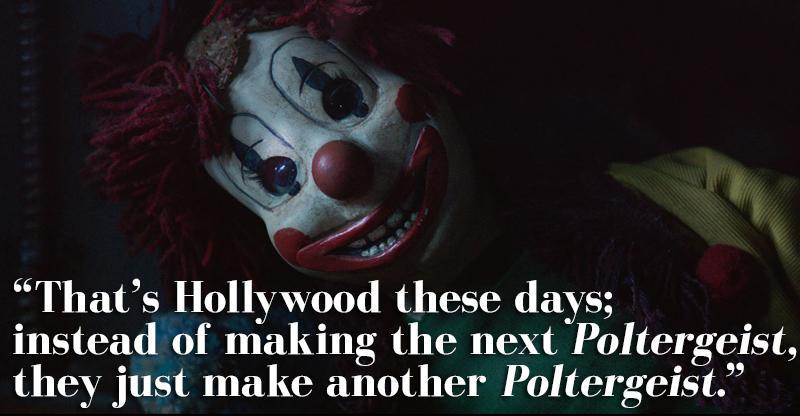
When things get rolling — a box of hideous clowns in the attic bedroom, a static-plagued iPhone, a box of books with a flair for unique stacking patterns — Kenan gives the scares a winking self-awareness that betrays the campy wit that launched Raimi’s career with the “Evil Dead” movies. Good times should be on the way, right?
After a late-night TV séance ramps up the party — complete with the classic “they’re here” line — Madison is taken away into an alternate dimension via her bedroom closet. Distraught, Mom and Dad do what any desperate parent would: They call the Ghostbusters.
Well no, not those Ghostbusters. A team of paranormal investigators and a TV spiritualist named Carrigan Burke (Harris) come on the scene to help, and right when “Poltergeist” should start getting good, it starts getting routine.
The disappointment is doubly painful because of the earlier promise. A mindless remake could be quickly dismissed and forgotten. But “Poltergeist’s” humorous edge and quality cast sets the bar just high enough for the film to bang its forehead.
Part of this has to do with the stripped-down plot. At 93 minutes — over 20 minutes shorter than the original — “Poltergeist” doesn’t give us much of a story. Rather than give us anything new, Kenan decided to stay safe, and the result falls flat.
There was plenty of opportunity for a modern twist. We don’t get a lot of character development in “Poltergeist,” but we know that Eric had been laid off, and the Bowens buy the house because they don’t have a lot of options. The new “Poltergeist” could be a reflection of the recession, but nothing happens. Even the cemetery subplot feels underdeveloped.
For about 20 minutes, “Poltergeist” gave you the feeling that you’re in for a fun time. But fun turned into routine way too fast.
“Poltergeist” is rated PG-13 for intense frightening sequences, brief suggestive material and some language; running time: 93 minutes
Joshua Terry is a freelance writer and photojournalist who appears weekly on "The KJZZ Movie Show" and also teaches English composition for Salt Lake Community College. Find him online at facebook.com/joshterryreviews.

‘Poltergeist’ Reviews Mostly Negative: The Horror Remake No One Asked For?

Is Poltergeist yet another horror remake no one ask for? Well, the reviews are in, and the majority seem to lean in that direction. The Poltergeist remake was the much hyped do-over brought to audiences by filmmaker Sam Raimi and director Gil Kenan. Raimi has some experience re-interpreting an existing horror franchise, as he was behind the American version of The Grudge.
Unfortunately, it seems like the Poltergeist hype relied more heavily on name-dropping and nostalgia than the promise of a truly inventive and very scary re-imagining of a legendary horror series. Critics of the horror remake are mainly unimpressed. As of now, Poltergeist has a 35 percent “rotten” rating on Rotten Tomatoes. According to the site, only 37 percent of audience members who chimed in about the movie actually liked it. So what went wrong for Poltergeist?


The new ‘Poltergeist’ is a decent remake that can’t escape the original. Our review: http://screencrush.com/poltergeist-remake-review/ …

Los Angeles Times reviewer Mark Olsen said that the Poltergeist remake was “a pleasant enough diversion”, but found it overall to be a “disconcertingly uneven outing.”
“The storytelling is choppy in a way that feels like some things were left in the cutting room. Amy and Eric attend an awkward dinner party that isn’t even talked about on the drive home. While the parents in the original film smoked a little pot when behind their bedroom doors, the Bowens have a drink or two, with a lingering, unexplored implication that Eric drinks a little too much.”
The remake was Poltergeist updated the technology but was too lazy in execution to inject any kind of worthwhile commentary. We are in a post-9/11, post-recession America; it would be sad to think that a blatant opportunity to give this remake life apart from the original was passed on for a shot-by-shot re-telling of a ground-breaking horror movie.
Michael O’Sullivan of the Washington Post found Poltergeist to be silly rather than scary, even going as far as to call the entire movie “laughable.”
To call Poltergeist laughable is not the same thing as saying it’s bad (although it is that, too.) It’s just that it seems less interested in scaring you than in making you chuckle.
In the end, this Poltergeist hoped by reintroducing the best-known elements of the original movie, which would be enough to classify it as a scary good time. Instead, what should be dated by modern standards remains decidedly more scary and authentic than the haphazardly put together re-interpretation.
If you want to see a throwback movie based on a decades-old franchise, you may want to pass on Poltergeist and go see Mad Max: Fury Road instead.
[Image Credit: 20th Century Fox UK]

Read more at http://www.inquisitr.com/2113214/poltergeist-reviews-mostly-negative-the-horror-remake-no-one-asked-for/#kkCB9uBmjPgqhzv7.99

Review 'Poltergeist' remake haunted by its original version

Within Hollywood's ongoing remake cycle, the 1982 hit "Poltergeist" is a choice both obvious and challenging. A touchstone for much in contemporary horror, with its emphasis on a family in peril, then cutting-edge effects work and some sly satire, the original "Poltergeist" was an efficient, intense haunted house story for and about its times.
Directed by Gil Kenan — nominated for an Oscar for his 2006 animated film "Monster House" — the remake is a disconcertingly uneven outing, not quite connecting in the manner of the original while also never standing firmly on its own two feet. The new "Poltergeist" is a pleasant enough diversion, better as a low-simmer suspense story than a full-blown effects extravaganza.
In the new film, Amy and Eric Bowen (Rosemarie DeWitt, Sam Rockwell) are moving into a more downscale house with their three children after Eric has been out of work for some time. As a series of unexplainable disturbances escalates, Amy and Eric learn their subdivision was built on land that was once a cemetery just before their youngest daughter, Madison (Kennedi Clements), becomes trapped in a supernatural spirit realm.
INDIE FOCUS: Sign up for Mark Olsen's newsletter about film
The Bowens appeal first to a parapsychologist (Jane Adams), who in turn brings in a medium/reality TV personality (Jared Harris). Together, they all try to get Madison back.
The '80s-era original, directed by Tobe Hooper, produced and co-written by Steven Spielberg, was about what might be lurking and repressed underneath the façade of a perfect suburban life, with Craig T. Nelson's dad character even seen reading a book on Ronald Reagan. The talk of layoffs and foreclosures in the new film shows that dream already broken from the start, so there is little other left for the otherworldly to reveal.
David Lindsay-Abaire, best known for his family trauma drama "Rabbit Hole," wrote the screenplay for the new film in which the kids have tablets and smartphones and young Madison becomes stuck inside a flat-screen. But nods to modernize the story never meaningfully connect it to the here and now, apart from the use of a flying toy drone as a tool to first visualize how things look on the other side of an interdimensional portal.
---------------------
'Poltergeist'
Rating: PG-13, for intense, frightening sequences, brief suggestive material and some language
Running time: 1 hour, 33 minutes
Playing: In general release