Poltergeist III
From Wikipedia, the free encyclopedia
| Poltergeist III |
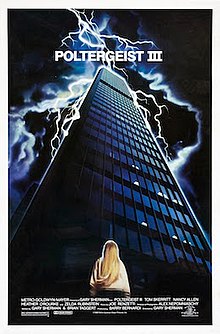
Theatrical release poster
|
| Directed by |
Gary Sherman |
| Produced by |
Barry Bernardi |
| Written by |
- Gary Sherman
- Brian Taggert
|
| Based on |
Characters
by Steven Spielberg |
| Starring |
|
| Music by |
Joe Renzetti |
| Cinematography |
Alex Nepomniaschy |
| Edited by |
Ross Albert |
| Distributed by |
Metro-Goldwyn-Mayer |
|
Release dates
|
|
|
Running time
|
98 minutes[1] |
| Country |
United States |
| Language |
English |
| Budget |
$10.5 million |
| Box office |
$14.1 million |
Poltergeist III (also known as
Poltergeist III: We're Back) is a 1988 American
horror film and is the third and final entry in the original
Poltergeist film series. Writers
Michael Grais and
Mark Victor,
who wrote the screenplay for the first two films, did not return for
this second sequel; it was co-written, executive produced, and directed
by
Gary Sherman, and was released on June 10, 1988 by
Metro-Goldwyn-Mayer Pictures. The film was panned by critics, and was a box office disappointment.
Heather O'Rourke and
Zelda Rubinstein
were the only original cast members to return. O'Rourke died four
months before the film was released and before post-production could be
completed. It was dedicated to her memory.
Plot
The Freeling family has sent Carol Anne (
Heather O'Rourke) to live with Diane's sister Pat (
Nancy Allen) and her husband Bruce Gardner (
Tom Skerritt).
Carol Anne has been told she is in Chicago temporarily to attend a
unique school for gifted children with emotional problems, though Pat
thinks it is because Steven and Diane just wanted Carol Anne out of
their house. Pat and Bruce are unaware of the events that the Freeling
family
had endured, only noting that Steven was involved in a bad land deal. Along with Donna (
Lara Flynn Boyle), Bruce's daughter from a previous marriage, they live in the luxury skyscraper (Chicago's 100-story
John Hancock Center) of which Bruce is the manager.
Carol Anne has been made to discuss her experiences by her
teacher/psychiatrist, Dr. Seaton (Richard Fire). Seaton believes her to
be
delusional; however, the constant discussion has enabled Rev. Henry Kane (
Nathan Davis)
to locate Carol Anne and bring him back from the limbo he was sent
during his previous encounter with her. Not believing in ghosts, Dr.
Seaton has come to the conclusion that Carol Anne is a manipulative
child with the ability to perform mass
hypnosis, making people believe they were attacked by ghosts. Also during this period, Tangina Barrons (
Zelda Rubinstein) realizes that Kane has found Carol Anne and travels cross-country to protect her.
That night, Kane drains the high rise of heat and takes possession of
reflections in mirrors, causing the reflections of people to act
independently of their physical counterparts. When Carol Anne is left
alone that night, Kane attempts to use the mirrors in her room to
capture her, but she escapes with the help of Tangina, who
telepathically tells Carol Anne to break the mirror. Donna and her
boyfriend, Scott, see a frightened Carol Anne running through the high
rise's parking lot, and move to rescue her; however, before they can,
all three are taken to the Other Side by Kane and his people. By this
point, Tangina and Dr. Seaton are both at the high rise, along with Pat
and Bruce. Dr. Seaton stubbornly assumes that Carol Anne has staged the
entire thing, while Tangina tries to get her back.
Scott is seemingly released from the Other Side through a pool in the
high rise, and Donna reappears after Tangina is taken by Kane disguised
as Carol Anne. Scott is left at his home with his parents. Nobody
notices that the symbols on Donna's clothing are reversed from what they
were before she was taken. As Dr. Seaton attempts to calm Donna, Bruce
sees Carol Anne's reflection in the mirror and chases her while Pat
follows. Dr. Seaton is not far behind, and he believes he sees Carol
Anne in the elevator. However, after Dr. Seaton approaches the elevator
doors, Donna appears behind him and pushes him to his death down the
empty elevator shaft. At this point it is revealed that what came back
was not Donna, but a reflection of her under Kane's control, which then
vanishes back into the mirror with a reflection of Scott at its side.
Pat and Bruce struggle to find Carol Anne, but Bruce is captured and
eventually Pat is forced to prove her love for Carol Anne in a final
face-off against Kane. Tangina manages to convince Kane to go into the
light with her. Donna, Bruce, and Carol Anne are returned to Pat. The
final scene shows lightning flashing over the building, and Kane's
laughter is heard.
Cast
Production
Director
Gary Sherman,
thought the idea of the city setting, was just as scary as isolated
suburbia. His feeling was that "there are people on the other side of
the wall, and no one cares that you are in trouble".
[2]
Unlike the previous films, nearly all of the special effects, were
live and were performed on stage. The only visual effect added in
post-production, was the lightning, casting over the
John Hancock Center in the very final shot of the picture. Sherman himself designed the special visual effects.
The reduced budget, meant that the filmmakers, were unable to afford the services of
Jerry Goldsmith, who had scored the first two films;
Joe Renzetti was hired instead.
Corey Burton returned to provide the voice work for Kane, although he was uncredited for this effort.
[3]
Death of O'Rourke
At the time
Poltergeist III began shooting in spring of 1987,
Heather O'Rourke had been ill for several months with what was misdiagnosed as
Crohn's disease,
and subsequently underwent medical treatment during parts of the
filming. Principal photography for the movie lasted from April 13 to
June 26 of that year , with June 10, 1988 as the film's scheduled
release date. After O'Rourke completed filming, she returned home to
California with her illness appearing to be in remission. However, in
late January 1988, O'Rourke suddenly became ill again, her condition
rapidly deteriorated, and she died on February 1, 1988 (barely a month
after her 12th birthday) during
Poltergeist III's post-production period.
After the completed film was rated PG by the MPAA in November 1987,
Sherman and the studio decided to re-shoot at least part of the ending
with a different special effects sequence. Planning and design for the
new SFX make-ups took place between December 1987 and January 1988, with
a possible shooting date set for early February. However, Heather
O'Rourke, the child star of the film, died on February 1. Initially
Sherman did not want to complete the film, but pressure from the studio
prevailed, and the entire ending was re-shot in March, 1988 using a body
double stand in for O'Rourke. In April, a re-edited version of the film
including the new ending was submitted to the MPAA, after which it
received a PG-13 rating. The finished film proved to be a critical and
box office failure. Sherman has said that although he is proud of
portions of the movie (particularly the creative use of mechanical "in
camera" effects instead of the traditional optical effects often seen in
movies of that genre), it is the least favorite of his films.
O'Rourke's death complicated MGM's marketing for
Poltergeist III, out of fear of appearing to be exploiting her death.
[4] Skerritt and Allen were discouraged from giving interviews about the film to avoid questions about O'Rourke's death.
[5]
Reception
The film received extremely negative reviews from critics, resulting in a 18% rating on
Rotten Tomatoes based on 17 reviews. Famed Chicago film critics
Gene Siskel and
Roger Ebert
both hated the film; both of them were extremely annoyed by the film's
excessive use of a certain screenwriting strategy of characters crying
out each other's names almost all the time; particularly the character
of Carol Anne. Ebert even noted that when he went to see the film, the
audience in the theater also became annoyed at the tactic, so the
audience started screaming back the names of the characters towards the
screen.
Rubinstein's performance earned rather mixed reviews, garnering nominations for a
Saturn Award and a
Razzie Award (which she also received previously for the
first sequel) at the same time.
Box office
Poltergeist III wound up being the lowest grossing and least attended film in the
Poltergeist trilogy. The film opened at #5, making $4,344,308 on its opening weekend, averaging about $2,953 from 1,471 theaters.
[6]
The bottom fell out from then on, as the film then fell out of the top
10 in only its second weekend, dropping 52 percent to only $2,093,783
(1,467 theaters, $1,427 average) ranking at #11, and bringing the 10-day
cume to $8,165,286.
Poltergeist III ended up with a domestic box
office total of $14,114,488. The film sold 3.434 million tickets at
1988's ticket price of $4.11, compared with 25.410 million tickets for
the first film, and 11.050 million tickets for the second film.
[7]
Awards and nominations
See also
References
"POLTERGEIST III (15)". British Board of Film Classification. June 22, 1988. Retrieved May 12, 2015.
E: True Hollywood Story: Curse of Poltergeist
"Interview with the Voice of Kane". PoltergeistIII.com. Retrieved 27 February 2011.
"Studio Unsure How To Market Latest 'Poltergeist' Movie". Lexington Herald-Leader (Lexington, Kentucky: Tim Kelly). 1988-03-27. p. J5.
Cieply, Michael (1988-03-21). "MGM Ponders Selling of `Poltergeist III'". Los Angeles Times. p. 6. Retrieved 2008-08-07.
"WEEKEND BOX OFFICE : 'Crocodile' Swamps 'Rambo'; Hanks' 'Big' Hit". Los Angeles Times. Retrieved 2012-06-10.
External links


