Tuesday, September 15, 2015

Film Review: “Poltergeist”
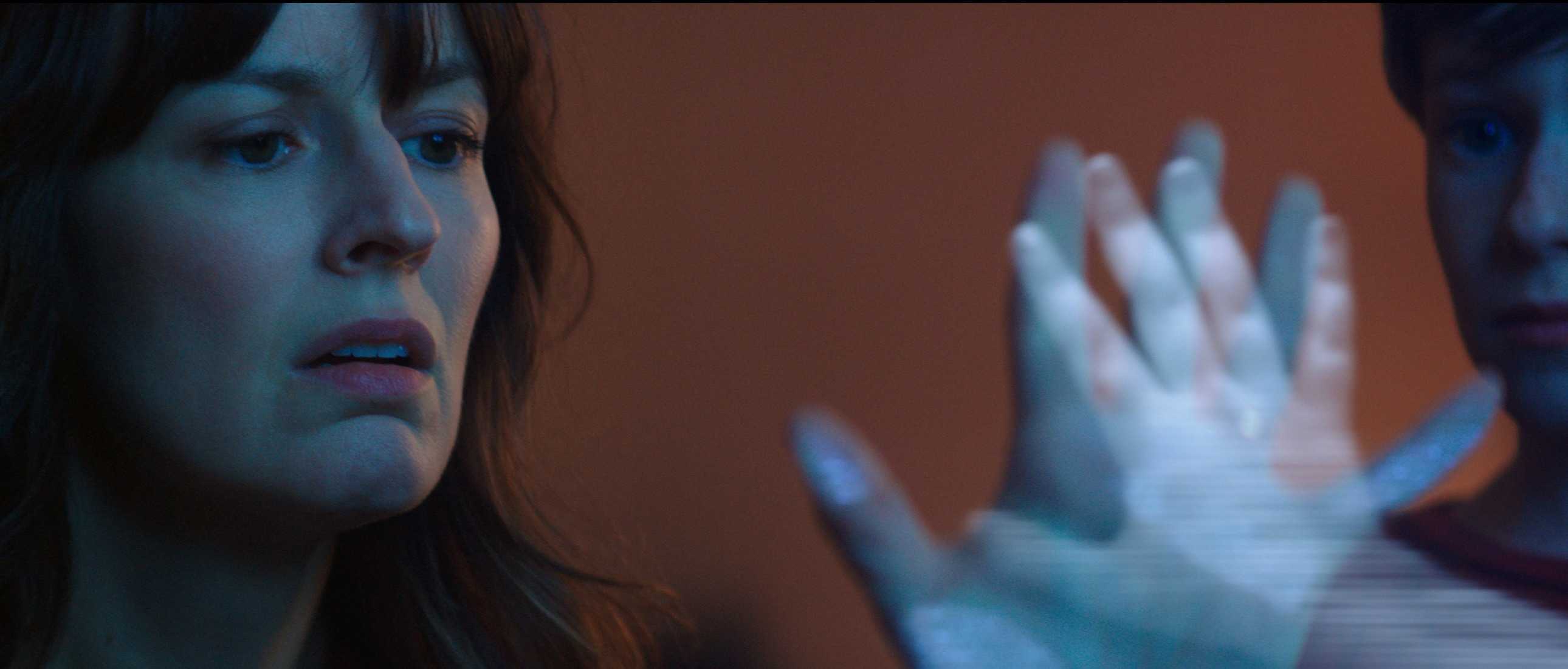
Film Review: “Poltergeist”

Conventional and irritating, “Poltergeist” is a horror remake as unwelcome as its paranormal invaders.
Photo used with permission from Twentieth Century Fox.
Rating 2.0/5.0
Directed by Gil Kenan
Starring Sam Rockwell, Rosemarie DeWitt, Jared Harris, Jane Adams
Rated PG-13
Release Date: May 22
All a fan can ask for is one great horror film per year. Just one! After the middling “It Follows,” “Poltergeist” was your best shot, 2015. But like the characters in this movie, you screwed up.
Based on the 1982 horror classic of the same name, “Poltergeist” follows a family of five in which the mom is an unemployed writer, the dad just lost his job and they’re so low on cash that their credit cards are getting declined. How do they solve these problems? A new house! To make up for this logic, or lack thereof, the filmmakers try to characterize their new house and neighborhood as undesirable. But come on. This ain’t the projects. The building is three stories tall and located in what looks quite like the suburbs.
Anyway, the family’s luck grows even worse when their lights start flickering, some clown dolls attack their son and a closet swallows their little girl. The movie is actually quite strong up to this point. The characters and relationships are set up well. The atmosphere is properly sinister and creepy. And Sam Rockwell, who plays the father, charmingly injects the film with a perfect dose of cool-dad humor. Then it all falls apart.
“They’re here.” The film recycles this iconic line from the original “Poltergeist” to instill dread within the audience. However, this time, one might interpret “they” as not referring to the house’s haunting spirits. “They” instead are a team of so-called “academic researchers” in the field of paranormal activity that the family enlists to help them get their daughter back. Rather than depicting the terror that the family experiences, the filmmakers instead decided to focus on three insanely incompetent “ghosthunters” who contribute virtually nothing to the film except — unintentionally — characters to point and to laugh at. Oh, the dread.
Photo used with permission from Twentieth Century Fox.
This group provides the laziest, hokiest explanations about what exactly a poltergeist is (“It’s not a haunting; it’s angrier and it could stop at any time” — what?) and where their daughter is (“She’s here, but not here” — okay, so where is she?). Pulling two circle-drawings apart to demonstrate dual existence didn’t help either. They then proceed to fail miserably at everything that the family recruited them to do. Thankfully, the family later brings in an actual poltergeist expert (Jared Harris), who happens to have his own television show about paranormal occurrences. How ironic is it that the only one who actually knows what he’s doing is the television-ghosthunter-star?
Besides this, the film’s naturalistic comedy that made the beginning so balanced and enjoyable descends into childlike farce. Director Gil Kenan fails to differentiate the humor of “Poltergeist” from his previous feature “Monster House,” an animated PG horror-comedy.
Ultimately, “Poltergeist” is irritating, which seems to be the quintessential feature of contemporary horror films. It doesn’t make sense and it possesses annoying characters that it neither needs nor benefits from. And as a remake, it lacks the elements necessary to significantly differentiate it from the original. Yes, visually, it’s updated. But the improvements start and end there.
For those wondering if “Poltergeist” is at least scary — using the film’s exposition techniques — it is, but it isn’t. You see how that works?

INVESTIGATING THE POLTERGEIST MOVIE CURSE

September 16, 2015

INVESTIGATING THE POLTERGEIST MOVIE CURSE

Primary tabs

Paul Dale Roberts's picture
INITIAL REPORT:
POLTERGEIST MOVIE CURSE - HPI INVESTIGATION/CLEANSING:

On 4/10/2015 - the Demon Warrior aka Paul Dale Roberts received a call on the paranormal hotline. A couple in Sacramento purchased an old Cabbage Patch doll that belonged to actress Heather O'Rourke (Carol Ann Freeling) of the Poltergeist movie film. Since the purchase of this cursed doll from EBay (it came with a Certificate of Authenticity), the family has had terrible tragedies happen to them. There has been deaths in the family also. My wife Deanna Jaxine Stinson and I, will be headed over to their home soon, to assist them in banishing this curse. This investigation / cleansing will happen at 7:30pm - April 17, Friday. 

FROM WIKIPEDIA - THE POLTERGEIST MOVIE CURSE:
The Poltergeist curse

The "Poltergeist curse" is a rumored curse attached to the Poltergeist trilogy and its crew, derived from the fact that four cast members died in the six years between the releases of the first and third films. The rumor is often fueled by the fact that real skeletons were used as props in various scenes of Poltergeist and Poltergeist II. The rumor and the surrounding deaths were explored in a 2002 episode of E! True Hollywood Story titled "Curse of Poltergeist".

Dominique Dunne, who played the eldest daughter Dana in the first film, died on November 4, 1982, at age 22 after being strangled by her abusive former boyfriend John Thomas Sweeney. He was convicted of voluntary manslaughter and sentenced to six years in prison, but was paroled after serving three and a half years.

Julian Beck, 60-year-old actor who played Henry Kane in Poltergeist II: The Other Side, died on September 14, 1985, of stomach cancer diagnosed before he had accepted the role.

Will Sampson, 53 years old, who played Taylor the medicine man in Poltergeist II, died as a result of post-operative kidney failure and pre-operative malnutrition problems on June 3, 1987.

Heather O'Rourke, who played Carol Anne in all three Poltergeist films, died on February 1, 1988 at the age of 12 during surgery to repair an acute bowel obstruction.

POLTERGEIST MOVIE CURSE - HPI INVESTIGATION/CLEANSING:
On 4/10/2015 - the Demon Warrior aka Paul Dale Roberts received a call on the paranormal hotline. A couple in Sacramento purchased an old Cabbage Patch doll that belonged to actress Heather O'Rourke (Carol Ann Freeling) of the Poltergeist movie film. Since the purchase of this cursed doll from EBay (it came with a Certificate of Authenticity), the family has had terrible tragedies happen to them. There has been deaths in the family also. My wife Deanna Jaxine Stinson and I, will be headed over to their home soon, to assist them in banishing this curse.

FROM DENISE ROBERTS HART FROM ENGLAND SAYS:
Hi Paul, I have only just come on line to see your post on the haunting of the doll purchased. I followed the story line of that beautiful little girl. It sounds like an angry spirit has attached itself to the doll believing it to be a human. The people who have the doll need to sit the doll in the sunlight and give it hugs. The noisy ghost is doing its best to get their attention, as they are in fear they are giving the doll focus and the spirit more energy. 
I am sending extreme love to the little doll and also to the people who now have her. I am sending you and your wife extra white light for protection. 
Love always, Denise X
Categories: 

Film Face-off: 'Poltergeist' 1982 vs 'Poltergeist' 2015

May 26, 2015
Disclaimer: No matter how this Film Face-off ends up, or what we all think of this remake, your childhood memories have not been ruined. The original film still exists the same as it always has. It has been 33 years, and with every other notable horror franchise getting rebooted in some sort of way, it was only a matter of time before we got a new Poltergeist. So, let's see if they could maintain, or possibly improve upon one of the scariest PG-rated horror films of all time. It's 1982 versus 2015.

The Tagline
Poltergeist (1982)
They're here.
Poltergeist (2015)
They know what scares you.
Winner: 1982. First, let's take a minute and discuss the use of "they." Both films have it wrong, right? A poltergeist is a singular thing. "It" is here. "It" knows what scares you. Right? Unless we want to call the films Poltergeists. Wait, where are you going? Fine, I'll stop with the grammar. The '82 film also sports the tagline "The first real ghost story." In either case, '82 wins. "They're here," is one of the most significant taglines, period. Who is here? It's creepy. The '15 tagline is like a challenge. Oh really? They know what scares me? They better, otherwise I've wasted my money. It's the same feeling you have when someone says, "I have the funniest thing in the world to tell you." You doubt.

The Family
Poltergeist (1982)
Craig T. Nelson is the dad, Steve Freeling. JoBeth Williams is the mom, Diane Freeling. Their kids are Dana (Dominique Dunne), Robbie (Oliver Robins) and Carol Anne (Heather O'Rourke).
Poltergeist (2015)
Sam Rockwell is the dad, Eric Bowen. Rosemarie DeWitt is the mom, Amy Bowen. Their kids are Kendra (Saxon Sharbino), Griffin (Kyle Catlett), and Madison (Kennedi Clements).
Winner: 1982. I worship Rockwell. You will too if you watch this -- Sam Rockwell: Dancing Machine. Sadly, none of this matters for the '15 film. While Clements has a good presence as little Madison, she isn't present for much of the film. Plus, they give Catlett (the slightly older brother) way too much to do, and end of missing the mother/daughter relationship. The '82 film establishes Diane as someone who is willing to do whatever she can, no matter how insane it might seem, to save her daughter. They also nail Steve and being completely overwhelmed and burnt out by the insanity. O'Rourke is a little blonde scene stealer.

The Others
Poltergeist (1982)
There are a group of parapsychologists from UC Irvine, Dr. Lesh (Beatrice Straight), Ryan (Richard Lawson), and Marty (Martin Casella), and Steve's boss, Lewis (James Karen). Most importantly, there is Tangina Barrons (Zelda Rubinstein), a spiritual medium.
Poltergeist (2015)
Amy goes to her alma mater and recruits Paranormal Research department to come to their house. It's Dr. Brooke Powell (Jane Adams), Sophie (Susan Heyward), and Boyd (Nicholas Braun). Carrigan Burke (Jared Harris) is a spiritual medium.
Winner: 1982. I don't need Harris to ever try on that accent in a film again. But even without it he wouldn't come close to the impact that Rubinstein has as the spiritual medium. She's just so wonderfully tiny, and that odd voiced only makes her more mesmerizing on the screen. In the '82 film Marty has that iconic moment with the steak and then his face peels off. Even though it looks dated now, it's a great use of practical effects that mentally scarred me as a child. Plus, he had it coming. Who just takes a steak from someone's fridge without asking? In the '15 film they give Boyd a potential scare with a drill in the wall. His foolishness simply means I didn't care.

The Clown(s)
Poltergeist (1982)
There is one really creepy clown.
Poltergeist (2015)
There are many really creepy clowns.
Winner: 1982. This is close. The '82 film begs the question, who the hell thought it was a good idea to buy a really creepy looking clown for a easily frightened boy? Plus, the actual choking doesn't hold up as a quality scare. The '15 film stumbles upon a pile of clowns begging the question, who hides a pile of clowns? Sadly, we'll never know the answer. The reason the '82 film gets the win is because of the wonderful pace, and camera angles when the clown first starts messing with Robbie.

The Poltergeist
Poltergeist (1982)
First some tables and chairs move around, then Carol Anne slides across the floor with a helmet. A tree tries to eat Robbie, everything spins in a room, and then "the Beast" makes his presence known.
Poltergeist (2015)
There's some sort of stick coming up from the ground, lights flicker when no one is around, cards stack up, flowers die, a tree grabs Griffin, Eric vomits mud and worms, and then the spirits really want Madison.
Winner: 1982. In the '82 movie, there is a charm to discovering the poltergeist. Plus, when things happen, it's in front of the Freelings, not simply for the audience to see (like the flickering lights). Also, the reason the tree tries to eat Robbie is to distract the parents and nab Carol Anne. The '15 film completely misses that point. The CGI of a bunch of spirits/souls clawing their way around in the update doesn't scare compared to one really upset poltergeist simply known as the beast.

OVERALL WINNER: Poltergeist (1982) defeats Poltergeist (2015) 5-0
It's a sweep. I couldn't think of one category where the new film would beat the original. Even the technological updates are sometimes good (GPS trackers, a helicopter drone) and sometimes bad (HD TVs and smart phones don't get visual static). Another annoyance is the layout of the new house, especially not understanding how amazing the main staircase is in the original film, which helps stage the action wonderfully. There is no reason the new film exists, except its marketable name. Thankfully, the 1982 film still remains the same.
Categories: Features


Saturday, September 12, 2015

Poltergeist Suburban ideology

by Douglas Kellner
from Jump Cut, no. 28, April 1983, pp. 5-6
copyright Jump Cut: A Review of Contemporary Media, 1983, 2005

Steven Spielberg is emerging as the dominant ideologue of affluent middle class America. In JAWS (1975), Spielberg depicts the transformation of Chief Brody from an antiheroic everyman, incapable of either stemming the economic and political corruption on the island or eliminating the shark, to a middleclass hero-redeemer who single-handedly destroys the shark and restores order to the community.(1) Brody thus becomes the first of Spielberg's middle class heroes. Whereas the novel jaws showed the sexual and class antagonisms between Brody and his wife, the film projects their closeness and love, presenting one of Spielberg's first idealizations of the middle-class family.
Although CLOSE ENCOUNTERS OF THE THIRD KIND (1977) shows the Richard Dreyfuss character torn away from his family and allegorically depicts the family's being torn apart by events and forces outside of its control, POLTERGEIST and E.T. elaborate idealized views of the family and the suburban middle class. Spielberg seems the most effective cinematic chronicler of affluent middle-class life-style, joys, and fears in contemporary U.S. society. CLOSE ENCOUNTERS, POLTERGEIST, and E.T. affectionately depict the commodity comforts offered by a consumer society. POLTERGEIST and E.T. show the rising affluence in the split-level suburban tract houses with their ever more advanced electronic media, toys, appliances, and gadgets. Spielberg celebrates this lifestyle and can be seen as film's dominant spokesperson for middle-class values and social roles.
Most interesting in Spie1berg's recent films is his symbolic projection of contemporary U.S. insecurities and fears. CLOSE ENCOUNTERS allegorically presents fears of losing one's family, job, and home. Also, it contains a scarcely disguised yearning for salvation through extraterrestrial forces, for deliverance from contemporary problems — a theme also present in E.T. but more pronounced in the novelization than in the film. In its depiction of UFOs and aliens, the film reverses the 1950s alien-invasion films codes, which depicted aliens as monstrous threats to the existing order. CLOSE ENCOUNTERS, POLTERGEIST and E.T. contain the fantasy that somehow beneficent forces will alleviate' threats to our security and well-being.
Ideologically, Spielberg's films traverse a contradictory field that in different films, or even in different scenes within a given film, celebrate and legitimate middle-class U.S. institutions and lifestyles or yearn for spiritual transcendence or both. E.T. mobilized its alien figure to highlight the commodities and joys of suburban family life — without, interestingly enough, the figure of the Law of the Father. The film depicts an alliance between the middle class and transcendent alien forces. God may no longer be on our side, but the aliens seem to be. The film reassures the middle class about their values and lifestyle and offers fantasies of reassurance that alien forces or the Other will be friendly and not threatening.
POLTERGEIST, on the other hand, symbolically probes both universal and specifically contemporary U.S. fears. It presents the shadow-side of suburban life in the form of an allegorical nightmare. It also has an utopian vision of the family’s pulling together and pulling through in the face of adversity and eventually triumphing over demonic forces. By articulating U.S fears and showing them conquered, the film defuses the nightmare quality of life in the U.S. horror show. By depicting with affection its residents, houses, goods, toys, and electronics, it presents advertisements for a U.S. way of life which defines happiness in terms of middle-class lifestyle and consumption.
Spielberg's films thus stand as clever ideological fables and do not just offer the pure fantasy entertainment which his defenders celebrate. His films are meticulously constructed ideology machines, planned in detail with elaborate storyboard models, well-crafted scripts, and cunningly planned-out special effects. Although he may or may not be a class-conscious ideologue, Spielberg's effectiveness as a purveyor of ideology derives from his identification with the affluent middle class and its way of life, which he appealingly reproduces.
Here I want to examine POLTERGEIST for what it shows about contemporary US society and Spielberg's ideological stratagems.(2) The film attempts to manipulate its audience through carefully planned, carefully paced jolts, special effects, frightening scenes, sentimental depictions of a loving family, and the assuring presence of technology, professionals, and spiritual powers. I shall first focus on POLTERGEIST's storyline, themes and ideology. Then I shall reflect on Spielberg's ideological problematic and his use of the occult.
A CUNNING IDEOLOGICAL FABLE FOR OUR TIME
POLTERGEIST depicts the trials of the Freeling family confronted with poltergeists, which haunt their house and spirit away their daughter, and with corpses, which return to life and destroy their house. The film uses the conventions of the horror-occult film, currently the most popular Hollywood genre, to explore suburban middle-class psychic and social landscape. The family unit contains a father, Steve Freeling, his wife, Diane, a teenage daughter, Dana, who is more connected to her friends than to her family, a young boy, Robbie, and little Carole Anne, who is about five and the first to make contact with the poltergeists. The Freelings live in one of the first houses built in phase one of a housing project called Cuesta Vista. The father is a successful real estate salesperson who has sold 42 percent of the housing units in the area — which his boss tells him represents over $70 million worth of property.
The opening scenes depict the Freeling family's environment and show close, loving relations between mother and father, parents and children. The film's power derives from its portraying the family's pulling together in the face of forces trying to tear it apart. Such positive images of the family have become increasingly rare in Hollywood, which instead in recent years has celebrated the couple or the single (usually male) parent or has ironically and satirically dissected family life and marriage (e.g. Robert Altman, Woody Allen). POLTERGEIST thus offers solace that the family stands as a viable institution, even in the context of contemporary troubles. It is one of the few "blockbuster" films that explicitly and unabashedly offer apologetics for the family.
The Freeling family idyll soon becomes interrupted by the poltergeists' presence. At first, they appear only to little Carole Anne through the medium of the television set. The poltergeists soon begin, however, more actively intervening. They shake the house, turn on appliances, bend and play with kitchen utensils, and make chairs slide across the floor. These scenes, I believe, celebrate middle-class commodity icons, showing the consumer society's bounty. During the night, the poltergeists become more menacing. In the midst of a thunderstorm, branches of a giant tree take Robbie out of the bedroom window; his parents desperately retrieve him from the forces of raging nature. At this point, little Carole Anne disappears and the family is thrown into panic.
The father then goes to Stanford and summons a group of parapsychologists to come investigate the phenomena. They in turn call in a diminutive woman spiritualist who tells the family how to deal with the poltergeists and how to get their daughter back. With the spiritualist's guidance, the mother enters the spirit world to retrieve her daughter, revealing the depth of her love and concern for the child. The mother emerges as the moral center of the film — and of the family. In Diane Freeling, POLTERGEIST presents a positive image of the New Mother, who is able to smoke dope, be sexy and modern, and yet also be a loved wife and nurturing mother. In response to the women's movement's critique of "women's place," Spielberg and company answer with the image of a mother who assumes her traditional role while she enjoys suburban affluence. The film thus cleverly supports traditional roles and institutions while it presents symbolic threats to the existing order.
As the film proceeds, it shows the house and its objects being progressively demolished. At first, objects fly around and are broken and shattered. Eventually the whole house is totally destroyed. These scenes play on fears of losing one's home in this era of rising unemployment, inflation, and economic hard times. The film evokes the horror of watching loved objects smashed, of seeing the tokens of the middle class systematically disintegrate. Finally the film offers a fable about the family's walking away from the ruins of suburban afflunce with the comforting assurance that the evil spirits have been vanquished, that the family is still intact, and that all will be well.
The "explanation" for the series of poltergeist disturbances is that the real estate development company, for which the father works, had built the housing project over a graveyard after removing the headstones but not removing the corpses. In the film's occultist text, the spirits of the dead wander about in a purgatorial spiritual dimension. They are unable to leave purgatory for the white light of bliss and apparently angered by their burial ground's desecration. After the corpses apocalyptically destroy the house over that burial ground, Steve yells at his boss, "You moved the cemetery. But you left the bodies, didn't you! You son-of-a-bitch, you left the bodies and only moved the headstones!"
Such a plot device highlights a critical theme in Spielberg's films and allows us to define more precisely the specificity of his ideological problematic. Clearly the villain is the greedy real estate developer who neglected to rebury the corpses to save time and money. Similarly, the villain of JAWS is the corrupt business-political establishment, which puts economic interests over people's safety and well-being. Spielberg does not defend the capitalist class or the economic and political elite. His representations of the state and political establishment tend to be critical. CLOSE ENCOUNTERS was initially intended to be a UFO Watergate-style cover-up, with the state's suppressing information about UFOs. This theme gets displaced in the film, but the state authorities still appear a bit menacing and sinister in the look of the film. Likewise, E.T. tends to present the adult world and especially state authorities from a low camera angle, the perspective of E.T. and the children. Consequently, state authorities usually appear threatening and sinister, even at the end when it appears that they are trying to save E.T.
Spielberg thus champions the middle-class ideologue but not the economic or political establishment His strategies reveal a crisis of ideology in the United States, where its most powerful and effective ideologues working in the cinematic cultural industries cannot or will not concoct ideological fables to legitimate the economic and political order. Legitimating these domains was precisely the ideological achievement of many films in Old Hollywood. But Capital and the State no longer have many successful ideological champions in Hollywood, although they may have in network television, albeit with contradictions and questionable success.
SPIELBERG'S OCCULTISM
Spielberg's most popular recent films, from CLOSE ENCOUNTERS to POLTERGEIST, participate in the resurgence of the occult, which has occurred in both Hollywood films and U.S. society since the end of the 1960s. When individuals perceive that they do not have control over their lives, they become attracted to occultism. During eras of socioeconomic crisis when people have difficulty coping with social reality, the occult seems to help explain incomprehensible events, with the aid of religious or spiritualist mythologies. Many recent occult films have served as vehicles for blatantly reactionary religious ideologies (e.g., THE EXORCIST, THE OMEN). Other filmmakers like George Romero, Wes Craven, and Larry Cohen have used the occult to present critical visions of U.S. society.(3) In contrast, Spielberg's use of the occult is neither systematically conservative-reactionary nor critical-subversive. Rather, it is marked by ambiguities which characterize his ideological problematic as a whole.
On one hand, Spielberg uses the occult to present rational contemporary fears: losing one's home, seeing one's family torn apart, fear of disease and bodily disintegration. For instance, in one of the most frightening scenes in POLTERGEIST, a young Stanford scientist goes to the kitchen and takes a steak out of the refrigerator. We see the piece of meat undergo a cancer-like metastasis, spewing out bizarre growths and organs before our eyes. The frightened scientist goes into the bathroom and washes his face and then looks into the mirror and sees his face mutate into rotting flesh. Although this hallucination disappears, he leaves the house and does not return. The scene is truly frightening, as it evokes fears of cancerous growth and bodily disintegration.
On the other hand, Spielberg's occultism serves as a vehicle to promote sentimental irrationalism. In his recent films, he constructs a spiritualist metaphysics out of representations of beneficent aliens, extrasensory perception, spirits, poltergeists, and magic (i.e., the children’s flying in E.T.). Fantasy and science fiction offer, of course, legitimate areas for film to explore. But the ubiquity of the occult in Spielberg's recent films provides an irrational worldview that feeds the already rampant irrationalism in U.S. society (i.e., religious revivalism, cults, "new age" spiritualism, etc.). Moreover, his occultist fables deflect people's legitimate fears onto irrational forces and create the false impression that deliverance will come from spiritual or extraterrestrial forces. Whereas a critical hermeneutic might find interesting symbolic projections of middle-class fears that relate to real socioeconomic crisis, most of the audience probably experiences these symbolic projections as deflections of their real fears, escape from contemporary U.S. monsters. As the films promote irrationalism and occultism, they cover over, rather than reveal, the origins, nature, and impact of the U.S. nightmare on people's lives.
Yet the weakest part of POLTERGEIST comes from the didactic occultism enunciated by the diminutive woman spiritualist, Tangina, who comes to help rescue Carole Anne and cleanse the house of the poltergeists. In two long, talky passages, she delineates the phenomenology of the spirit world and explains the source of Carole Anne's problems and the poltergeist disturbances. Throughout the film the viewer sees manifestations of the spirit world and is thus led to believe in the existence of spirits and an afterlife. Here Spielberg recycles old religious-spiritualist ideologies to reassure the audience about its deepest fears (i.e., descent into death, nonbeing, total nothingness) and provides a set of metaphysical representations useful for traditional, religious ideologies.
Spielberg provides reassuring fantasies that soothe fears concerning disintegration in this life (i.e., the family, the American dream, etc.) and in an afterlife. One of the tasks of cinematic ideology is to enunciate fears and then to soothe them. Spielberg magnificently accomplishes this in his fables of reassurance. While the contemporary United States is wracked with deep doubts and fears concerning its socioeconomic, political, and cultural system, Spielberg plays on these fears, finds (perhaps unconsciously) cinematic representations for them, and offers fantasies of reassurance. His ideology machines are popular precisely because of their effectiveness in enunciating and defusing such contemporary fears. Much more interestingly than the mindless, reactionary drivel concocted by George Lucas, Steven Spielberg has become the dominant ideologue of the middle class. However, now that he has become wealthy and powerful, it will he interesting to see if he moves on to become an ideologue for the economic-political establishment. In the meantime, it is as ideological fables that Spielberg's films should be interpreted and criticized.
Notes
1. On the transformation of Brody to hero-redeemer, see the discussion in John Lawrence and Robert Jewett, The American Monomyth (Garden City, N.Y.: Doubleday, 1977). On the class problematics of JAWS, see Fredric Jameson, "Reification and Utopia in Mass Culture," Social Text 1 (Winter 1979). See also the following articles and Critical Dialogue in JUMP CUT on JAWS: Peter Biskind, "Between the Teeth" (No. 9, October-December 1975); Dan Rubey, "The Jaws in the Mirror" (No. 10/11, June 1976); Robert Wilson, "JAWS as Submarine Movie" (No. 15, July 1970). JAWS and Spielberg's other films will be discussed in more detail in the forthcoming book Politics and Ideology in Contmporary American Film by Douglas Kellner and Michael Ryan. This article is indebted to work done with Ryan on the ideologies of contemporary film.
2. POLTERGEIST is directed by Tobe Hooper while Spielberg is credited as producer and one of the writers. Spielberg claims that the story idea was his. The film concludes with, "A Steven Spielberg Film." Alleged tensions arose between Hooper and Spielberg. There is debate over whose film it really is — as if a collective enterprise "belonged" to one person. In fact, the film offers an amalgam of the cinematic styles and philosophies of Hooper and Spielberg. The film exhibits Hooper's flair for the suspenseful, odd, and horrific and Spielberg's affection for the middle-class, fuzzy-minded occultism, and nose for the market. In any case, there are enough Spielbergian elements in it to justify analysis of the film in terms of Spielberg's ideological problematic.
3. On the problematics and ideological contradictions in contemporary horror films, see the studies collected in Andrew Britton, Richard Kippe, Tony Williams, and Robin Wood, American Nightmare: Essays on the Horror Film (Toronto: Festival of Festivals Publication, 1979) and the studies in Kellner-Ryan (forthcoming).

Film: Poltergeist III

Poltergeist III (1988) is the second of two sequels to the horror film Poltergeist.
It shows the malevolent spirits following Carol Anne to the high-rise apartment building where she has been sent to live with her aunt and uncle.

This film provides examples of:

  • Idiot Ball: Dr. Seaton clearly saw poltergeist activity in the scene where a coffee cup is flung through a one-way mirror, but he continued to insist that everything was a result of Carol Anne's manipulation. This leads to a plot line where definite poltergeist activity is happening all over the place but blame continues to be put on 'manipulative' Carol Anne for being the cause of all the problems. After Dr. Seaton proposes this theory, it seems to be aunt Pat who believes it most in her attempts to place blame:
    Pat: Your daughter's upstairs, a shivering, emotional wreck. Then you run out on me to chase after that evil little brat again. Don't you understand? Don't you see what [[Carol Anne]]'s doing? It's just like Dr. Seaton said.
    Bruce: Nothing Seaton said explains what happened tonight.
  • I'm Cold... So Cold...: Lara Flynn Boyle's shower scene.
  • Parental Substitute: In this film, Carol Anne had been sent by her family to live with her aunt and uncle in a different part of the country. Her aunt, being her mom's sister, is a bit colder towards her in comparison to her uncle, who in spite of only being related to Carol Anne by marriage ironically fills this role better of the two parental substitutes.
  • Real Life Writes the Plot: Tragically, Heather O'Rourke, the girl who played Carol Anne, died unexpectedly on February 1, 1988, before post-production on the film was completed. As a result, the ending was hastily rewritten with Tangina offering herself as a sacrifice substitute to rescue the others kidnapped by Kane. A substitute actress filled in for Carol Anne, and her face is hidden from view as Tangina rescues them.
  • What Happened to the Mouse?: Bruce, Carol Anne, and Donna all come back safe from the Other Side, but what happened to Scott?
    • According to the actor who played Scott (Kip Wentz), he wasn't contacted by the director when reshoots were done (this was the second ending, filmed a month after Heather O'Rourke died) and he didn't find out that a new ending was shot until shortly before the film opened. The team outright admitted in the haste to reshoot they simply forgot about him.